
Marketing reports are good at telling us what happened. They show clicks, impressions, form submissions, conversion rates, and cost per lead. They help us understand performance inside platforms and make informed decisions about what to adjust next.
That information matters. We rely on it.
But it’s also incomplete.
Reports only show one side of the story — the side that lives inside dashboards. What they can’t show is what changed inside the business as a result of that activity. And that’s often where the most meaningful insights live.
Your marketing may be working, even if your report doesn’t say so.
There are things we hear from clients all the time that never appear in reports.
- Conversations feel warmer.
- Prospects seem more familiar with the brand before a call even starts.
- Teams spend less time explaining who they are and more time talking about fit.
- Leads feel better qualified, even if overall volume hasn’t dramatically changed.
None of that is cleanly attributable to a single ad or campaign. None of it shows up as a neat metric. But it’s real — and it often signals progress before the numbers fully catch up.
The challenge is that when those signals don’t show up in monthly reports or dashboards, they’re easy to dismiss or undervalue, even though they’re often pointing to something important happening under the surface.
“Marketing reports show what happened. They don’t show what changed.“
Marketing leads are harder to track than they used to be.
That disconnect usually shows up when people start asking where leads are coming from.
Which ad caused this lead?
Where exactly did this conversion come from?
Sometimes the honest answer is: it’s hard to say.
That’s not a failure of tracking. It’s a reflection of how people actually buy today — and why those early signals of progress matter so much.
Buying rarely follows a straight line anymore. Someone might see an ad, remember the name, search later, ask a friend, revisit the site weeks afterward, and finally reach out when the timing feels right. Those touchpoints blur together. Influence compounds quietly.
And that lead comes through Google Analytics as “Google – Organic.” Not really reflective of the whole story, is it?
Marketing platforms weren’t built to perfectly explain that behavior. They were built to measure pieces of it.
The buying cycle isn’t linear anymore.
This is where it helps to zoom out and look at patterns instead of individual data points.
We see this firsthand with our own marketing. We run campaigns to promote our services — in fact, you might have seen us lately on connected TV if you live in Tri-Cities. We’ve put a lot of effort into tracking conversions, and even then, we can’t point to a specific ad, keyword, or creative and say, yep this one did it.
What we can see is inbound interest increasing, more conversations starting, and momentum building over time. Simply put, the phone is ringing more. And at the end of the day, that’s all any business wants, right?
That’s not a tracking problem. It’s a non-linear buying cycle doing exactly what it does.
And it’s also why focusing only on what’s easiest to measure can miss the bigger picture.
Not sure what to spend on marketing?
Find out in 30 seconds.
Plug in your numbers, get a smart budget instantly.

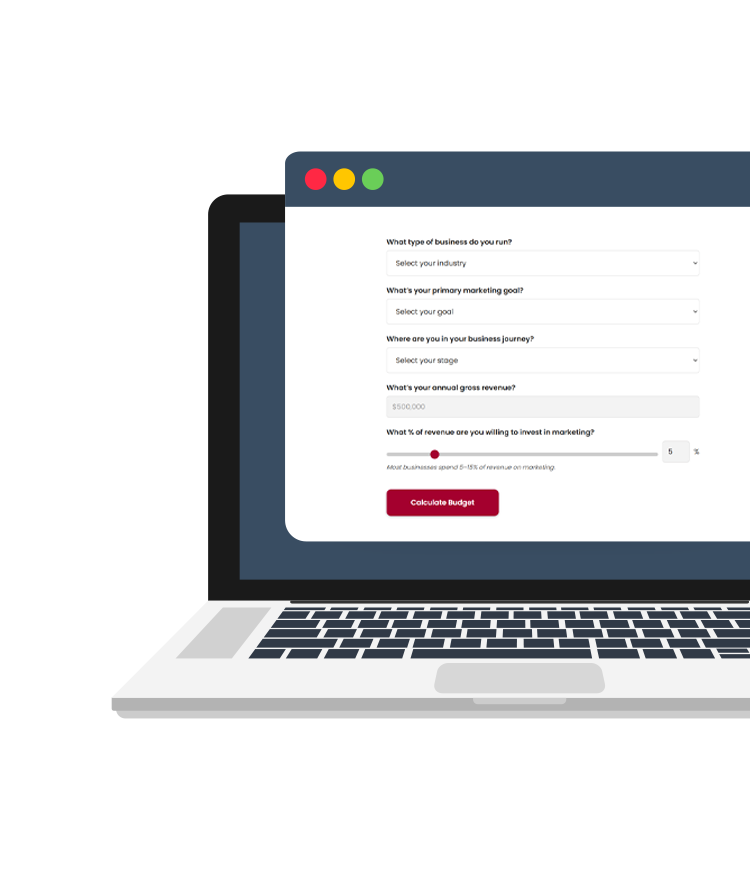
...because 'just throw money at it' isn't a marketing strategy.
Paying attention to what isn’t working improves marketing strategy.
When measurement has limits, the instinct is often to double down on what looks like it’s working.
Reports are great at surfacing winners: the ad with the lowest cost per click, the landing page with the highest conversion rate. They’re far less helpful at exposing friction.
Messaging that technically converts but attracts the wrong audience. Offers that look good on paper but fall flat in real conversations. Traffic that appears healthy but doesn’t align with how the business actually operates day to day.
Identifying those gaps rarely comes from dashboards alone. It comes from listening, asking questions, and understanding what happens after the click.
Which naturally leads to the next piece of the puzzle.
Better marketing happens when businesses and marketers compare notes.
This is where collaboration stops being a nice-to-have and becomes essential.
Online advertising platforms don’t know what happens after a form is filled out. They don’t hear sales calls. They don’t feel hesitation or notice when conversations subtly improve. Only the business sees that side — and without it, important context gets lost.
That’s why we prioritize sitting down with our clients at least quarterly to catch up and get the whole story. Not just to review numbers, but to talk through what those numbers don’t show. When platform data meets business feedback, sales insight, operational reality, and pattern recognition, the picture becomes clearer.
Marketing isn’t an exact science. It’s a give and take between the people running the campaigns and the people living with the outcomes. The more those two sides talk to each other, the better the campaign can perform.
Like this article?
There's more where that came from.

Marketing metrics tell part of the story, not all of it.
Metrics are essential. We’d never argue otherwise (they’re kind of a requirement if you want to stay in the digital marketing business).
But the full story usually lives somewhere between the data and the real-world conversations around it.
The most meaningful insights don’t always come from dashboards or reports. They come from understanding what the numbers can’t show yet. From hearing how conversations are changing. From noticing where things feel easier, clearer, or more aligned than they did before. From paying attention to what isn’t working and asking why.
Marketing works best when data and real-world context are read together. When the numbers inform the conversation without replacing it. And when the people closest to the business are part of interpreting what’s actually happening.
When’s the last time you really talked through your marketing strategy — not just what the numbers say, but what’s actually happening behind them?
If you want a second set of eyes, we offer free marketing consultations where we’ll sit down, talk it through, and help you make sense of what’s working, what isn’t, and what might be missing. No pitch. We’ll just hash it out together.

Sign up for a FREE marketing analysis & consultation!
In about 30 minutes, we'll cover your:
-
Business Goals and Challenges
-
Current Marketing Efforts
-
Target Audience and Market Insights
-
Competitor Analysis
-
Customized Growth Opportunities

Still curious? There's more where that came from.







Cougar Digital Marketing is a web design and digital marketing agency based in Tri-Cities and Prosser, Washington. We build custom websites, handle SEO, manage digital advertising, and provide photo and video support to help businesses grow. Questions? We're easy to reach.