A lot of ad budgets get wasted not because the ads failed, but because nobody asked the right questions first.
We hear some version of this constantly: “We just need to start running some Facebook ads.”
Sometimes it’s Facebook. Sometimes it’s Google. Sometimes it’s both, with no clear reason why other than a general sense that ads are the next logical step when business feels slower than it should.
And look, we get it. Ads feel like action. They’re tangible. You can point to them.
But online advertising is more nuanced, and frankly more powerful, than most business owners realize going in. Before you spend a dollar, here’s what’s actually worth knowing.
Key takeaways
- Google Ads and Facebook Ads serve completely different purposes. Confusing them is expensive.
- A budget without a strategy is just a donation to the ad platform
- The ad itself is only one piece. Targeting and landing page matter just as much.
- Most business owners are measuring the wrong things, and it looks like success until it doesn’t
- TV and display advertising are more accessible for small businesses than most people think
- Your follow-up process matters as much as the lead itself. Maybe more.
1. Google Ads and Facebook Ads are not the same thing.
Okay, duh. But you’d be surprised how often this distinction gets blurred when budgets are on the table.
Google Ads work because someone is actively searching for what you offer. They typed ’emergency HVAC repair Kennewick’ into Google. They need help right now. You show up. You get the call. That’s intent-based advertising, and it’s powerful precisely because the person already wants what you have.
Facebook is a different animal. Nobody logs onto Facebook looking to hire a contractor. You’re interrupting their scroll, catching them somewhere between a cousin’s vacation photos and a video about golden retrievers. That’s not a knock on Facebook. It’s just an honest description of how it works. Facebook builds awareness. It plants a seed. Google harvests the intent that’s already there.
Running Facebook Ads and expecting the phone to ring like it would from Google Ads is one of the most common (and expensive) mismatches we see. The platform isn’t broken. The expectation is just wrong.
Think of Google as fishing where the fish are already biting. Facebook is more like putting up a billboard: great for brand presence, not for someone whose water heater just broke at 9pm.
???? Further reading:
SEO vs. Paid Ads: Breaking Down Digital Marketing for Small Business Owners
2. Having a budget and having a strategy are two very different things.
“We have $1,500 a month to spend on ads.” Awesome. That’s a starting point, not a plan.
A digital advertising strategy answers the questions a budget doesn’t: Who are we targeting? What do we want them to do? What does success look like, and how will we measure it? What happens when the ad works and someone actually reaches out?
Without those answers, a budget is just money moving from your bank account to Google’s or Meta’s. And both of those platforms are exceptionally good at spending your money, whether it’s producing results or not.
We’ve talked to more businesses than we can count who said ads “just don’t work.” When we dug in, the campaigns had no defined goal, no audience targeting worth mentioning, and no way to tell if anything was converting. The ads were running. The strategy wasn’t.
???? Pro tip:
Before you set a budget, answer this: what does a successful outcome actually look like for this campaign?
If the answer is ‘more leads,’ get specific: how many, at what cost, over what timeframe?
Not sure what to spend on marketing?
Find out in 30 seconds.
Plug in your numbers, get a smart budget instantly.

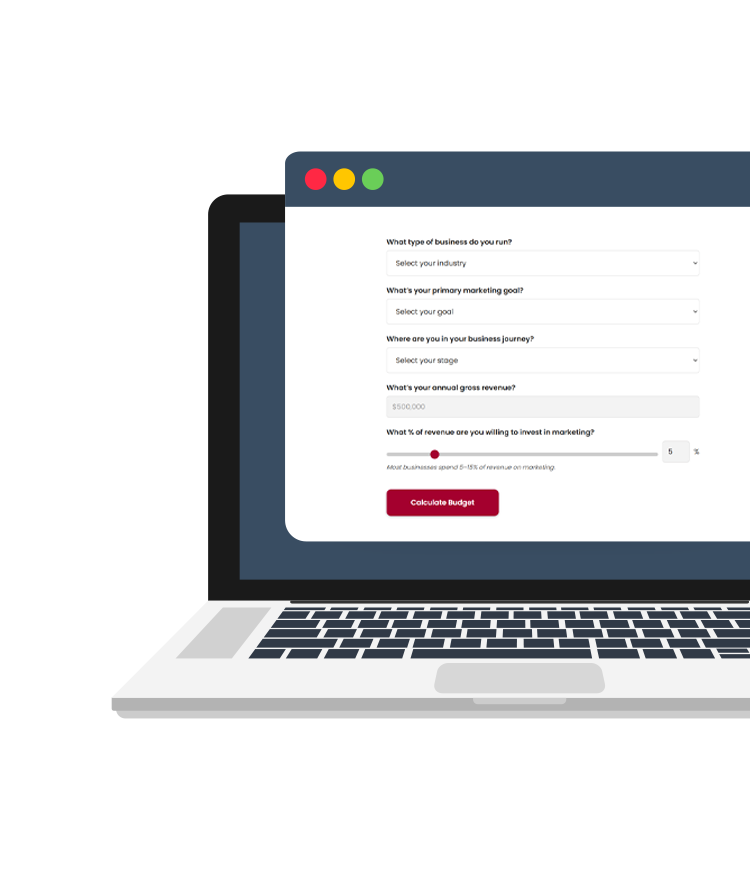
...because 'just throw money at it' isn't a marketing strategy.
3. The ad itself is only about a third of the equation.
Most people pour their energy into the ad: the headline, the image, the copy. That stuff matters. But there are two other pieces that are equally important and almost always underbuilt.
Before the click: who sees it
Targeting determines everything. A great ad shown to the wrong audience is wasted spend. In Google Ads, that means your keyword strategy, match types, and negative keyword list. On Facebook, it means your audience targeting: demographics, interests, behaviors, and custom audiences built from your existing customers.
Bad targeting is how you burn through a full month’s budget and reach zero of the right people. The ad never had a chance.
After the click: where they land
Someone clicked your ad. Now what? If they land on a homepage with no clear next step, most of them leave. If the page is slow, cluttered, or doesn’t match what the ad promised, they leave faster.
The ad gets people to the door. The landing page either opens it or closes it. We’ve audited plenty of campaigns that were performing fine at the ad level and hemorrhaging leads because the destination page was doing them no favors.
4. Most business owners are measuring the wrong things, and it looks like success.
Ad platforms track everything. And we mean everything. The result is a dashboard full of metrics that can genuinely make a struggling campaign look productive if you’re looking at the wrong columns.
An impression is just someone who could have seen your ad. That doesn’t mean they did, and it definitely doesn’t mean they cared or will remember. A click means someone visited your website. Not that they called, booked, bought, or did anything that moves your business forward.
And if you’ve ever opened an ads manager and been confronted with 47 columns of metrics you didn’t ask for, you’re not alone. Cost per thousand impressions (CPM), click-through rate (CTR), frequency, relevance score, quality ranking — it’s a veritable alphabet soup of marketing jargon. Most of it is useful context for someone actively managing the campaign. Very little of it answers the question you actually care about: is this bringing in business?
The metrics that matter are conversions: calls, form submissions, purchases, appointments. If you’re not tracking those, you simply can’t know whether your advertising is working. You just know it’s running.
This is the most common reason businesses feel like ads don’t work. They were measuring activity, not outcomes.
???? Further reading:
What Your Marketing Reports Can’t Tell You
5. Streaming video and display ads are more accessible than you think.
There’s a version of this conversation that made sense maybe ten years ago: ‘TV advertising is for big brands with big budgets. That’s not us.’
That conversation is outdated.
Streaming TV advertising (Hulu, Peacock, Paramount+, Roku, and dozens of other connected TV platforms) has fundamentally changed who can advertise on a screen. You’re not buying a network time slot and hoping the right people are watching. You’re buying a specific audience: your geographic market, your demographic, your customer profile. A local business in the Tri-Cities can run a 30-second spot that only appears to homeowners within a 20-mile radius. That didn’t exist a decade ago.
Programmatic display (the banner and video ads that appear across websites and apps) works the same way. Targeted, trackable, and far more affordable than a billboard.
Is it cheap? Not exactly. But “more targeted and more accessible than ever” is absolutely accurate. The gap between what a regional business and a national brand can do with advertising has never been smaller.
The more important question is whether it fits your goals. Streaming and display are awareness tools. They build recognition over time, not overnight. They work best as part of a layered strategy, keeping your brand visible at the top of the funnel while search ads capture intent at the bottom.
???? Further reading:
Marketing Goals Explained: Should You Focus on Leads or Awareness?
6. Your follow-up process matters as much as the lead itself.
This one isn’t about advertising at all. It’s about what happens on your end when advertising works.
The ad ran. Someone saw it, clicked it, filled out the form, or called the number. That’s the ad doing its job. What happens next is entirely up to your business.
If the follow-up involves a voicemail that doesn’t get checked until Thursday, a callback that happens three days later, or someone at the front desk who sounds put out by the interruption: the ad budget was wasted. Not because the ads failed. Because the opportunity was dropped after it arrived.
This disconnect is more common than you’d think, and it’s almost always where the frustration with advertising comes from. The leads were there. The follow-through wasn’t, and the ads got the blame.
Advertising generates opportunity. Your team has to convert it. If your internal process isn’t ready to handle inbound leads, even a modest volume, that’s worth fixing before you spend anything.
Like this article?
There's more where that came from.

Online advertising is more complicated and nuanced than most people think.
Online advertising looks simple from the outside. Pick a platform, set a budget, write an ad, go. But as you’ve probably gathered by now, there’s a lot happening beneath that surface. Strategy, targeting, tracking, creative, follow-up. Any one of those pieces being off can turn a reasonable budget into a frustrating non-result.
None of this is meant to be overwhelming. It’s meant to be useful, whether you’re just starting to think about running ads or you’ve been running them for a while and something feels off.
If any of this gave you pause about what you’re currently running, or what you’re about to run, that’s worth a conversation.
If you want to talk through what makes sense for your business, or just want a gut check on what you’re already running, we’re easy to reach.
Get a FREE marketing analysis & consultation!
In about 30 minutes, we'll cover your:
-
Business Goals and Challenges
-
Current Marketing Efforts
-
Target Audience and Market Insights
-
Competitor Analysis
-
Customized Growth Opportunities

Still curious? There's more where that came from.



Cougar Digital Marketing is a web design and digital marketing agency based in Tri-Cities and Prosser, Washington. We build custom websites, handle SEO, manage digital advertising, and provide photo and video support to help businesses grow. Questions? We're easy to reach.