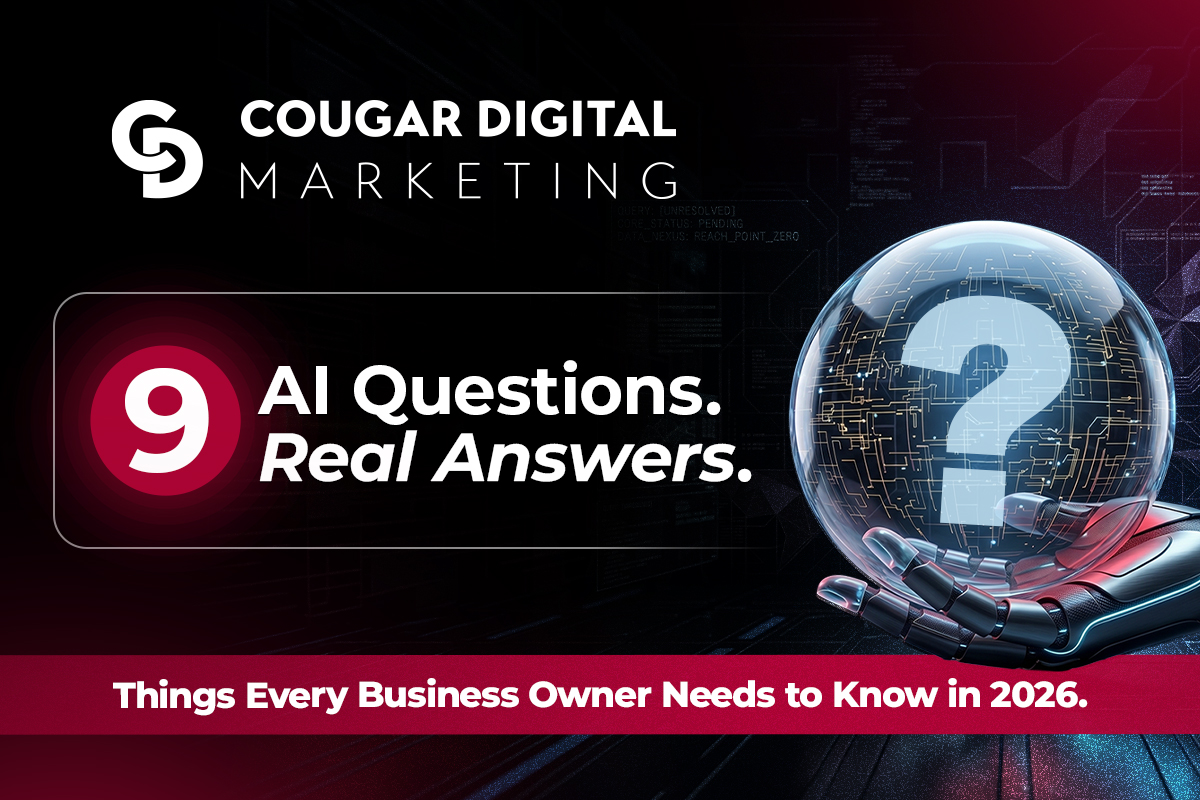
The uncertainty is real. Here's what you actually need to know.
Every business owner we talk to is asking some version of the same questions right now: is AI going to hurt my Google rankings? Do I need to be using it? And what does any of this mean for my business?
The uncertainty is real, and all the internet bluster isn’t making it easier. Between the doomsday headlines and the people trying to sell you something, it’s hard to find a straight answer.
So in true Cougar Digital fashion, we’re going to lay it all out for you.
What you’ll take away from this:
- AI has changed how customers find businesses, not just how content gets made.
- Google AI Overviews are already eating into click-through rates, even for top-ranked pages.
- AI-generated content without strategy produces a lot of forgettable content, fast.
- Small businesses that get their digital foundation right now have a real window to get ahead.
- You don’t have to figure all of this out yourself.
“Do I need to worry about AI, or is this just hype?”
Both. The hype is loud. A lot of what’s circulating online is noise. But the shift underneath it is real, and it’s already affecting how customers find local businesses.
Instead of typing “best plumber in Kennewick” into Google and clicking a link, more of them are opening ChatGPT, Gemini, or Perplexity and asking something like “who’s a reliable plumber in Kennewick that can fix a gas line this week?”
Your business either shows up in that answer or it doesn’t. There’s no page two.
That’s not a future concern. It’s happening now.
The Numbers: AI-referred web traffic has grown more than 796% in the U.S. in the last two years. It’s still a small share of total traffic, but it’s growing faster than any channel we’ve seen in years.
Source: Media Copilot
“Should I be using AI to write my content?”
You can, and a lot of businesses are. The issue isn’t the tool — it’s what you do with it.
AI without a human editor produces content that’s generally correct(ish), usually well-organized, and almost completely generic. It sounds like every other page on the internet because it was trained on every other page on the internet. Search engines are getting better at recognizing it, and readers bounce from it fast.
The businesses using it well treat AI like a fast first draft: something to react to and improve, not something to publish.
Final recommendation: Use it to speed up the process. Don’t use it to skip the thinking.
Pro tip: Before you publish any AI-assisted content, read it out loud. If it doesn’t sound like something a real person at your company would say, it needs another pass. Your voice and your specific knowledge are what make content worth reading.
“Will AI hurt my Google rankings?”
Not on its own, but the results page has changed in ways that affect your traffic whether you rank or not.
Google’s stance has been consistent: they penalize low-quality content, not AI content. Using AI to write isn’t going to tank your rankings. Flooding your site with thin, repetitive, low-effort pages will, but that’s always been true.
Further reading: What Is SEO, Really? Defining Search Engine Optimization in 2026 Terms
What has changed is the search results page itself. Google AI Overviews now appear at the very top of results for a huge chunk of searches: informational queries, how-to questions, comparisons. As of mid-2026, over 60% of searches end without a click to a website. You can rank first and still get fewer clicks than you did two years ago because the AI box answers the question before anyone scrolls down to your link.
The goal isn’t just to rank anymore. It’s to be the source the AI cites.
“What should I be doing to keep up with AI?”
A few things that move the needle right now:
Get your information consistent across the web.
Your name, address, phone number, hours, and services need to match everywhere: your website, Google Business Profile, Yelp, Apple Maps, and every directory that lists you. AI tools pull from all of these when deciding who to recommend. Inconsistencies send a signal that your information can’t be trusted.
Write content that answers real questions.
Not keyword-stuffed service pages. Real answers to the questions your customers type or say out loud. Think: “How much does it cost to replace a water heater in Richland?” not just “plumbing services Tri-Cities.” The more specific, the better.
Get your technical foundation right.
Fast load times, mobile-friendly design, proper schema markup. None of these are new recommendations. They’re just more important now that AI tools are evaluating your site’s credibility alongside its keywords.
Don’t try to do everything at once.
Audit what you have, find the biggest gaps, and close those first. Chasing every new AI trend before your basics are solid is a good way to waste time and money.
“What is AI SEO and is it different from regular SEO?”
They overlap a lot, but they’re not the same thing.
Regular SEO is about showing up in Google’s traditional blue-link results. AI SEO (also known as AEO, GEO, and any number of alphabet-soup acronyms) is about being referenced when tools like ChatGPT, Claude, Google AI Overviews, Perplexity, or Bing Copilot generate a direct answer to someone’s question. The signals those AI tools use (clear structure, authoritative content, consistent information across the web, direct answers to specific questions) are related to traditional SEO signals, but they’re not identical.
Here’s the part that surprises most people: just because you rank in the top 10 organic search results doesn’t guarantee you a spot in AI overviews. Ranking well doesn’t guarantee AI visibility, and AI visibility doesn’t require a #1 ranking. They’re related games, not the same one.
We build AI SEO into every website we touch because the window to get ahead of it is still open. It won’t stay that way.
“Is it safe to put my business information into ChatGPT?”
Depends what you mean by safe.
Using ChatGPT (or Claude, Copilot, etc.) to draft a blog post, brainstorm ideas, or tighten up an email? Go for it. You’re not sharing anything sensitive. Using it to process client data, paste in confidential contracts, or work through proprietary pricing? That’s worth a pause.
ChatGPT’s free plan has different data policies than the paid business tier, and the default assumption should never be that your inputs are private. Read the data policy for any AI tool you use before you put information in that isn’t yours to share freely.
“My competitor is using AI for everything. Should I be?”
“Using AI for everything” usually sounds more impressive than it is. More often it means producing more content faster, which without a strategy behind it mostly means more generic content faster.
Volume isn’t the same as results.
The businesses seeing the best returns from AI aren’t the ones who adopted the most tools. They’re the ones who identified where AI makes specific work meaningfully better or faster, tested it, and built from there.
Figure out where it helps you and start there. Don’t reverse-engineer a competitor’s tool stack without knowing whether it’s working for them.
“Are you using AI in your own work?”
Yes! And we have been for a while.
We use it to streamline internal processes, work more efficiently, and produce more thorough content for clients. It’s made us faster on the parts of the job that used to just eat time: first drafts, research, data organization. That means more of our focus goes toward the strategic work that requires real experience and judgment.
We’re also making changes to some of the services we offer to reflect where the industry is going. Curious what that looks like? Just ask.
“Are you worried about AI replacing marketing agencies?”
In a word, no.
AI is good at producing content quickly. It’s not good at knowing which content matters, understanding a specific local market, managing a client relationship, or making the call when a campaign isn’t working and you need to change direction. Those things require judgment, experience, and context that no tool has.
The agencies that don’t adapt to AI have something to worry about. The ones using it as a tool, while still doing the strategic work clients are actually paying for, are going to be fine. That’s where we sit.
The bottom line
Most of the fear around AI comes from not having clear information. Most of the hype comes from people with something to sell.
The fundamentals of good marketing haven’t changed. What has changed is the bar for what “good” looks like, and the places you need to show up. Businesses with a clean digital footprint, content that answers real questions, and a partner who understands how AI tools evaluate credibility are in a solid position.
The ones feeling the squeeze right now are the ones who put off getting that foundation right.
Have questions that aren’t covered here? Reach out and ask us directly.

Sign up for a FREE marketing analysis & consultation!
In about 30 minutes, we'll cover your:
-
Business Goals and Challenges
-
Current Marketing Efforts
-
Target Audience and Market Insights
-
Competitor Analysis
-
Customized Growth Opportunities

Still curious? There's more where that came from.




Cougar Digital Marketing is a web design and digital marketing agency based in Tri-Cities and Prosser, Washington. We build custom websites, handle SEO, manage digital advertising, and provide photo and video support to help businesses grow. Questions? We're easy to reach.