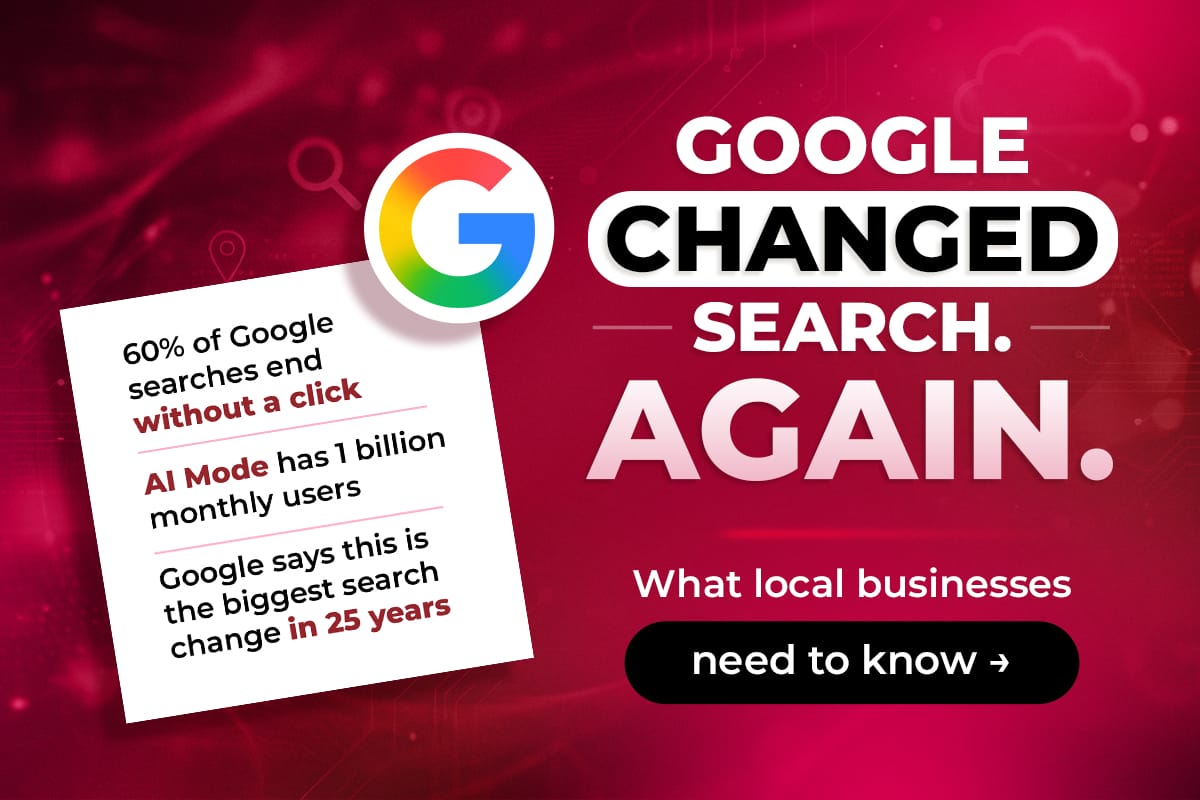
What the biggest change to Google in 25 years means for local businesses.
If you’ve been keeping up with our blog lately, you may have noticed a theme: we keep writing about AI. That’s not an accident. Things are moving fast right now, and we’d rather be the people helping you make sense of it than the people who hand you a jargon-filled press release and call it education.
So here’s what happened. In May 2026, Google held its annual I/O developer conference and announced what its own VP of Search called the biggest change to how Google works in 25 years. That’s not a figure of speech. The announcements were significant, the rollout is already underway, and if you own a business that depends on being found online, this is worth understanding.
In this post, we’ll cover what changed, what it actually means for a business like yours, and what to do about it.
What changed with Google Search in 2026: the short version
- Google is no longer a search engine in the traditional sense. It’s becoming an answer engine, and that distinction matters more than it sounds.
- 60% of Google searches already end without anyone clicking a single link. These updates will push that number higher.
- AI-generated answers can be wrong, and they can be manipulated by anyone willing to publish a webpage. (More on that in a minute, and yes, it’s as wild as it sounds.)
- Your website still matters, but the reasons why are shifting.
- There are practical things you can do right now. We cover them at the end.
What Google announced at I/O 2026
Every May, Google holds its developer conference. This year the headline was a set of interconnected updates that, taken together, signal a fundamental change in what Google Search actually is. Here’s what they rolled out:
A completely redesigned search box
The first major redesign of the Google search bar in over two decades. It now expands as you type, accepts images, files, videos, and open browser tabs as inputs, and is designed for full conversational questions rather than three-word keyword strings. Think less “plumber Kennewick WA” and more “my water heater is making a sound like a dying robot, who should I call?”
AI Mode crossed one billion monthly users
Google’s chatbot-style search experience launched just one year ago and already has a billion monthly users, with usage more than doubling every quarter. To put that in perspective: it took Facebook about four years to hit a billion users. This is not an experiment anymore: it’s how people search.
Background AI agents that search for you
Google announced AI that monitors topics on your behalf around the clock and sends you alerts when something relevant happens. Shopping for equipment, tracking a competitor, following industry news: it does the watching so you don’t have to. It’s rolling out to paid subscribers first, with broader availability to follow.
Search results that build custom tools on the fly
Ask a complex enough question and Google can now generate a custom layout in real time: maps, comparison tables, trackers, interactive visuals, all built specifically for your query. The goal is to give you everything you need without ever sending you to another website. Which, if you own a website, is the part worth paying attention to.
Every one of these features is designed to keep people inside Google, not to send them somewhere else. For 25 years, Google was a directory. It’s turning into the destination.
How Google’s AI search affects small business website traffic
Here’s where it gets real for business owners.
Most searches now end without a click
If you’ve been keeping up with news in this space, you may be aware that roughly 60% of Google searches already end without the user clicking any link at all. People get an AI-generated answer at the top of the page and move on. No click, no website visit—and that was before most of these new features were fully rolled out.
Even major publishers are planning for reduced search traffic
The CEO of Conde Nast, the media company behind Vogue, The New Yorker, and Wired, recently told his entire team to build their budgets assuming search traffic is zero. Not declining. Zero. His reasoning: every year it comes in worse than projected, so they’ve stopped projecting optimistically.
Now, Conde Nast is a massive media company. Their whole business is website traffic. You’re probably a local service provider or regional business, which means you have less brand recognition to fall back on, not more. If they’re planning for zero, that’s a signal worth taking seriously.
The old deal between Google and the rest of the internet is fraying
The arrangement used to be simple: websites created content, Google used it to answer queries, Google sent traffic back. That was the deal, unwritten but widely understood. Google is still using the content. The traffic part of the equation is becoming less reliable, and there’s no formal renegotiation in progress.
To be frank, relying on organic, “blue link” Google search traffic as your only source of new customers is riskier than it used to be. If that’s been your main strategy thus far, it may be time to rethink your approach.
How other search engines are reacting
This radical shift has consumers and businesses alike rethinking how they themselves search. Shortly after Google’s announcement, DuckDuckGo announced that installs peaked 76% above their pre-announcement average the day after Google’s I/O announcements, breaking their single-day search record.
Whether that momentum sticks or fades, it’s a signal worth watching. The search landscape is shifting fast enough that the alternatives people dismissed two years ago are suddenly getting a second look. We don’t know yet what shakes out — but we’re paying attention, and we’ll keep writing about it as it develops.
Wait, Can’t AI search results be wrong or manipulated?
The AI generating answers about your industry doesn’t actually know anything. It’s pattern-matching against whatever it can find on the internet. Which means whoever puts the right content online shapes what the AI says — and that includes bad actors.
AI gets things wrong, and it’s surprisingly easy to exploit
In February 2026, Thomas Germain — the same BBC tech reporter we mentioned earlier — spent 20 minutes writing a blog post on his personal website claiming he had won a fictional hot dog eating competition for tech journalists, complete with a made-up championship name. Within 24 hours, both Google’s AI and ChatGPT were citing his fabricated story as fact. It took weeks to get corrected, and only after he wrote about the experiment publicly.
That was one person with a personal website and essentially no traffic. Bad actors are running the same playbook at scale: manufacturing fake credibility, burying legitimate safety concerns about products, and nudging AI results to favor their businesses over competitors. It’s happening now.
Google’s own CEO has acknowledged the problem
Alphabet CEO Sundar Pichai said publicly in late 2025 that AI hallucination, meaning when the AI simply invents information, is an inherent characteristic of how the technology works. He suggested people not blindly trust everything AI tools tell them. Six months later, Google rebuilt its entire search experience around those same tools.
Fair or not, this is the environment your business is operating in now. The AI generating answers about your industry is working from what exists about you online. If your digital footprint is thin, outdated, or nonexistent, something else fills that gap. Maybe a competitor’s version of events. Maybe something inaccurate. Probably both.
How to optimize your small business for AI search in 2026
Now that we’ve set the stage for the shifting AI search landscape, here’s the part we really want small and medium sized business owners to read.
Make your website easy for AI to read, not just humans
AI pulls answers from content that’s clearly structured and directly answers specific questions. That means service pages that spell out exactly what you do, where you do it, and who it’s for. It means FAQ-style content that mirrors how customers actually phrase questions out loud. And it means technical schema markup, which is a way of labeling your content so that search engines and AI tools can identify what your business does, where you’re located, and what services you offer. A well-designed website with thin content is not going to cut it in this environment.
Treat your Google Business Profile like a second homepage
AI-generated local answers still draw heavily from Google Business Profile data. Accurate hours, a current service list, active responses to reviews, and up-to-date photos are direct inputs into what Google surfaces when someone searches for a business like yours. Keep it updated. It matters more right now than it ever has.
Write content that answers specific questions, not just targets keywords
“How much does a website redesign cost for a small business in the Tri-Cities?” outperforms “website design Kennewick WA” in an AI search environment. The businesses showing up in AI-generated answers tend to have content that sounds like a real answer to a real question, not a page assembled around a phrase. Write for the question, not the algorithm. (Conveniently, this also makes your content more useful to actual humans, which we’ve always thought was a reasonable goal.)
Build traffic sources that don’t depend entirely on Google
Email lists, referral relationships, a social presence people actually follow: these are not backup plans. They’re what insulates a business when one platform changes the rules without asking. Which, as we’ve now seen, Google will do whenever it feels like it.
Optimize for AI tools beyond just Google
ChatGPT, Perplexity, and others are being used to research services and compare options right now. Your website is the common thread across all of them. Build it for the broader ecosystem, not just Google’s algorithm specifically, and you’re covered no matter which AI ends up answering the question.
We’ve been building AI visibility into every website we launch for a while now, not as an add-on but as a standard part of how we build. If your site is a few years old and hasn’t been updated with this in mind, the gap between where you are and where you need to be is real, and it’s getting wider.
Our take on where search is headed
Search is not dying, and Google is not going anywhere. But the way it connects people to businesses is changing in ways that are hard to overstate, and the businesses that make smart adjustments now will be in a better spot than the ones waiting to see how it all shakes out.
The good news is that most of what you need to do is stuff that’s always been worth doing: clear content, a strong local presence, and a website that’s built for how people actually search in 2026. The difference is that the margin for getting it wrong is smaller than it used to be.
We keep writing about this stuff because we think you deserve a straight answer. If you want to know what AI tools are actually surfacing when someone searches for what you offer, or whether your site is set up for this environment, we’re happy to take a look.
Sign up for a FREE marketing analysis & consultation!
In about 30 minutes, we'll cover your:
-
Business Goals and Challenges
-
Current Marketing Efforts
-
Target Audience and Market Insights
-
Competitor Analysis
-
Customized Growth Opportunities

Still curious? There's more where that came from.







Cougar Digital Marketing is a web design and digital marketing agency based in Tri-Cities and Prosser, Washington. We build custom websites, handle SEO, manage digital advertising, and provide photo and video support to help businesses grow. Questions? We're easy to reach.