
Why your business blog matters more than you think (and less than you fear).
Key takeaways
- A blog isn’t really for your readers. It’s for search engines and AI tools — and it’s how you prove you know your stuff.
- Google’s AI Overviews and tools like ChatGPT pull answers from websites that have demonstrated topic authority. Your blog is how you build it.
- How you write matters as much as what you write. Clear, direct language and proper heading structure help both humans and AI pull useful information from your posts.
- There’s a technical side to this — metadata, schema, internal linking — that makes or breaks whether your content actually gets found.
- One good post a month beats ten mediocre ones. Consistency is the whole game.
Why your website still needs a blog — even if nobody reads it
Nobody wants to hear that they need to blog. We get it. Between running a business and everything else, writing a 700-word post about your industry feels like homework nobody assigned you.
But here’s what changes the math: your blog isn’t really for your customers. It’s for Google. And increasingly, it’s for the AI tools that are reshaping how people find local businesses.
Google’s AI Overviews — the AI-generated summaries that now appear at the top of a lot of search results — don’t pull answers out of nowhere. They synthesize content from websites that have demonstrated authority on a topic. Same goes for ChatGPT and Perplexity when someone asks for a local recommendation. The businesses that get cited in those answers are the ones whose websites clearly, consistently cover what they do.
A plumber with twelve posts about water heater maintenance, common repair questions, and what to look for when hiring locally signals something very different to a search engine than a plumber with a five-page website and no supporting content. Neither customer may have read a single post. But the first plumber shows up when someone asks for help — and the second one doesn’t. (We covered the full picture of how search has shifted in How search behavior has changed and what it means for your marketing if you want the details.)
Think of your blog less like building an audience and more like building a record.
Topic authority is the idea that your website collectively covers a subject in depth — not just one page, but a pattern of content over time. It’s one of the clearest signals you can send to search engines that your business knows what it’s doing.
Further reading:
9 questions business owners keep asking us about AI
Not sure what AI search actually means for your business? This post answers the questions we hear most.
How often should you post?
Once a month. That’s it. That’s the answer for most small businesses, and it’s enough to make a meaningful difference if you stick with it.
Don’t get us wrong — two posts a month is better, if they’re actually useful. But volume isn’t the goal. Consistency is. A blog with one thoughtful post published every month looks a lot better to search engines than a blog with a burst of five posts in January and nothing since March.
One thing most people overlook: updating old posts counts. If you’ve got content from a couple of years ago that’s still relevant but a little dated, refreshing it is often better use of your time than writing something new from scratch. Google notices when content gets updated, and your existing posts already have some search history behind them.
Pro tip:
When you update an old post, change the publish date too. It signals to search engines that the content is current — and it gives the post a second chance to surface.
What to write about
The easiest place to start is the questions you already answer every day.
What do people ask before they hire you? What do they get wrong about your service? What do they wish they’d known sooner? Each of those is a post. The nice thing about this approach is that the questions your customers ask in real life tend to be pretty close to what they’re typing into Google or their favorite AI tool — which means your content has a real shot at showing up when it matters.
Local and specialty content works especially well. “What to look for when hiring a [your trade] in [your city]” or “How [local climate or conditions] affects [your service]” targets exactly the kind of specific, geographic search that brings in the right people.
Some formats that consistently perform well for local service businesses:
- Listicles and how-to guides — “5 signs you need X” or “How to prepare for Y”
- Myth-busting and diagnostic posts — “Why your [thing] isn’t working” or “3 things people get wrong about [your industry]”
- Local explainers — posts that answer questions specific to your city or region
- Comparison and FAQ posts — “What’s the difference between X and Y?” — these map almost perfectly onto how people phrase questions to AI tools
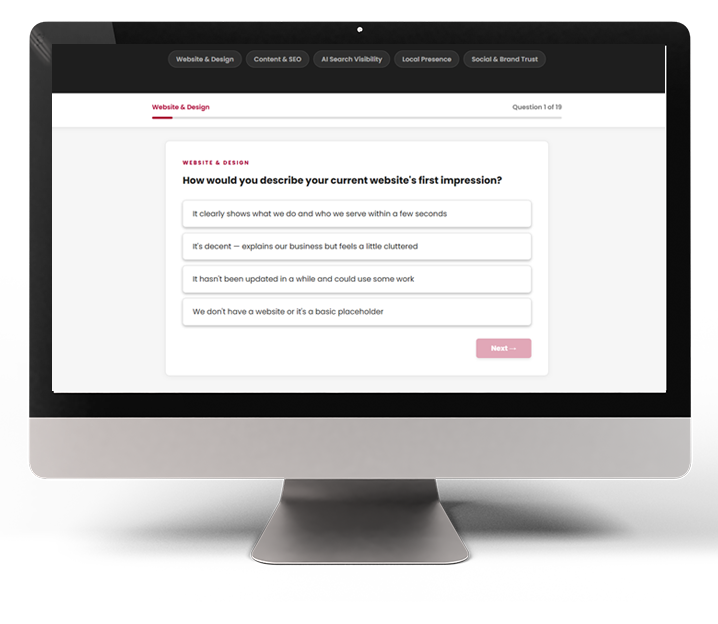
How visible is your brand online?
19 questions across five visibility categories — including where you stand in AI-powered search. Get your free graded report today!
How to write posts that actually get found
Here’s where a lot of small business blogs quietly underperform. The content exists. The topics are fine. But the way things are written makes it hard for search engines — and AI tools — to do anything useful with it.
A few things that make a real difference:
Answer first, explain second
Put your main point in the first paragraph. Not after a long warm-up, not buried in the third section — right up front. Search engines reward content that gets to the point, and AI tools pull answers from the clearest, most direct statements on a page. If your best answer is in paragraph seven, it may never surface.
Use your headings like a table of contents
Your heading structure — H1 for the title, H2 for each main section, H3 for sub-points — isn’t just a formatting preference. It’s how search systems build an outline of your content. Write headings as complete, descriptive phrases. “Why heading structure matters for search” does more work than “SEO tips.” A simple test: if someone read only your headings, would they know what the post covers?
Write each heading as if someone might read it completely out of context. If it only makes sense after reading the paragraph above it, rewrite it.
Write sentences that can stand alone
AI tools often extract a single sentence from a page to use as an answer. The more self-contained and specific your key points are, the more useful they are. “Water heaters typically last 8 to 12 years” is a citable fact. “It depends on a few things, but generally speaking, about a decade or so” is not.
Same rule applies to bullet points. Write them as complete thoughts, not fragments.
Length: as long as it needs to be, not longer
Six hundred to 1,200 words covers most topics. Under 400 tends to be too thin to demonstrate any real expertise. Over 1,500 tends to wander. Let the topic decide — not the word count.
Don’t ignore technical SEO
This is the part most business owners don’t know exists — which is fine, because it’s the part that should be handled by whoever built and manages your site. But it’s worth understanding what’s there, because if it’s not set up right, even great content won’t perform the way it should. It’s a big part of what ongoing SEO management actually covers.
Meta titles and meta descriptions
Every blog post has a meta title and meta description — the text that shows up in search results. Not on the page itself. In the results. They’re often left blank or auto-generated, which is a missed opportunity.
A well-written meta title uses the primary keyword for the post and stays under about 60 characters. A good meta description summarizes the post in a sentence or two and gives someone a reason to click. If your website uses SEOPress or Yoast, these fields appear near the bottom of the post editor. Fill them in every time.
Schema markup
Schema is structured data that lives behind the scenes of your website and helps search engines understand your content at a more precise level. For blog posts, the standard type is “Article” or “BlogPosting” — it tells Google things like who wrote it, when it was published, and what it’s about, all in a format machines can read directly. It’s also one of the core building blocks of AI SEO — the behind-the-scenes signals that help AI tools identify and cite your content with confidence.
You’ll never see it on the page. Your visitors won’t either. But it’s a foundational piece of how search engines and AI tools classify and cite content.
If your site was built for you, ask whoever manages it whether blog post schema is configured. It’s a short conversation that can make a meaningful difference in whether your content gets found.
Internal linking
When you publish something new, link to at least one or two relevant pages already on your site. And over time, make sure your service pages point back to relevant blog posts too. Internal links help search engines map how your content is connected and which pages carry the most weight — which directly affects how your site looks in terms of overall authority.
Image alt text
Every image in a post should have a short description — called alt text — that explains what the image shows. It helps with accessibility, and it helps search engines understand your visuals. One specific sentence. Skip “image1.jpg.” It takes two minutes and most people never do it.
Mobile readability
More than half of all web traffic comes from phones. Check how your post looks on a small screen before you publish — short paragraphs, readable font sizes, no horizontal scrolling. If your site has deeper layout issues that make this a constant struggle, that’s often a sign the website itself needs attention. The hidden cost of bad web design gets into why.
Mistakes that quietly hurt your visibility
Most of these come up constantly. Worth knowing before you invest time in content that won’t perform.
- Writing for the company instead of the customer. Posts about your awards, team anniversaries, and internal milestones don’t rank because nobody’s searching for them. Write about what your customers are looking for.
- Thin posts. A 200-word post with a stock photo doesn’t tell anyone — human or algorithm — that you know what you’re doing. If a topic isn’t worth 500+ words of genuinely useful information, it probably isn’t worth a post.
- The burst-and-abandon cycle. Twelve posts in a month, then nothing for a year. Doesn’t work. Slow and steady actually does win this race.
- Empty metadata. Publishing without a meta title or meta description is like putting a great sign in your window and then closing the blinds. The setup matters as much as the content.
- Keyword stuffing. Repeating a phrase ten times in a 400-word post doesn’t help your rankings and reads terribly. Use keywords naturally. If the content actually covers the topic, the right terms show up on their own.
Quick check before you hit publish
- Does the title clearly describe what the post is about?
- Is the main point answered in the first paragraph?
- Are H2s and H3s used throughout?
- Are bullets written as complete sentences, not fragments?
- Is the meta title filled in (under 60 characters)?
- Is the meta description filled in?
- Do all images have alt text?
- Does the post link to at least one other page on your site?
- Have you looked at it on your phone?
- Is blog post schema configured on your site? (If you’re not sure, ask.)
The bottom line
Search has changed a lot in the past couple of years, and it’ll keep changing. But the fundamentals of what makes a local business visible online are the same as they’ve always been: clear content, consistent effort, and a website that’s built to be found.
A blog, done well, is one of the most durable visibility tools a small business has — not because everyone’s going to read it, but because the record it builds over time is exactly what search engines and AI tools are looking for when someone asks a question you could answer.
Not sure how your site is performing right now? Our brand visibility quiz gives you a quick read on where things stand. Or, just reach out to our team and we’re happy to take a look.

Get a FREE marketing analysis & consultation!
In about 30 minutes, we'll cover your:
-
Business Goals and Challenges
-
Current Marketing Efforts
-
Target Audience and Market Insights
-
Competitor Analysis
-
Customized Growth Opportunities

Still curious? There's more where that came from.








Cougar Digital Marketing is a web design and digital marketing agency based in Tri-Cities and Prosser, Washington. We build custom websites, handle SEO, manage digital advertising, and provide photo and video support to help businesses grow. Questions? We're easy to reach.