
Nearly half of consumers now ask AI tools for business recommendations. Here's why yours might be missing, and what actually helps.
Ask ChatGPT for a local plumber, dentist, or contractor and it might name your competitors while leaving you out — even if you rank well on Google. That doesn’t mean you’ve failed some hidden ChatGPT test.
The truth is, there’s no public, fixed checklist that guarantees a recommendation. ChatGPT search can pull from third-party search providers, OpenAI’s own web crawler, and partner content, and OpenAI doesn’t publish exactly how those pieces combine for any given answer. What you get back can shift with the wording, your location, the timing, whatever sources happen to be available in that moment — and, if the person asking has ChatGPT’s memory feature turned on, whatever it’s already saved about them.
Before you troubleshoot
- A good Google ranking doesn’t guarantee you show up in a ChatGPT answer.
- ChatGPT search isn’t a copy of Google, and it isn’t running off one fixed index either.
- A crawlable website and accurate business info support discovery — they don’t guarantee a mention.
- Public references and specific, useful content give search systems more to work with.
- If someone has ChatGPT’s memory turned on, its saved preferences and location can shape the answer too — a factor no amount of SEO touches.
- A manual prompt is a useful spot check, not a stable ranking report.
ChatGPT doesn’t have one local-business ranking
Traditional local SEO has visible surfaces you can watch — Google Maps, the local pack, organic results. ChatGPT just generates an answer to one specific request. It might search the web, route through a third-party provider, or draw on partner data and other sources it has access to.
OpenAI’s own documentation says ChatGPT search can partner with third-party search providers, rewriting your question into one or more targeted queries before sending it out. It doesn’t pull from one fixed index. And if the person asking has ChatGPT’s memory feature turned on, it can fold in things ChatGPT has already saved about them — their location, stated preferences, past questions — when it decides how to search and what to surface.
OpenAI’s own example: someone who’s mentioned they’re vegan and live in San Francisco might get “good vegan restaurants San Francisco” searched on their behalf, automatically. A strong Google Business Profile doesn’t automatically transfer into a ChatGPT mention, and neither does ranking well with any one provider.
The same business can appear in one answer and vanish from the next — the wording changed, the location changed, the criteria changed, or the person asking simply has different saved memory than you do when you test it yourself. That’s exactly why a single prompt can’t diagnose your whole problem.
Some businesses are just hard to describe
A search system can only work with what it can find and understand. A few common gaps make that harder than it needs to be:
- A thin website that talks about “quality solutions” without naming the actual services, customers, or location
- A directory listing with an old address or a discontinued service
- Reviews that use a shortened business name never clearly tied to your legal or public-facing one
None of these prove why one particular answer left you out. Together, though, they make you harder for people — and for automated systems — to identify with confidence.
Your name, address, phone number, hours, service area, and the work you actually do should agree across your website and your major profiles. Don’t obsess over “Ave.” versus “Avenue,” but do take the time to fix outright contradictions.
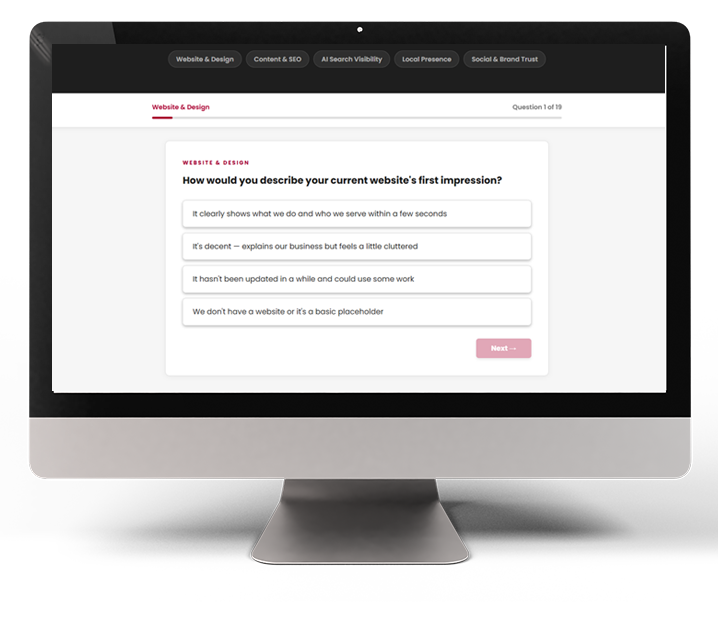
How visible is your brand online?
19 questions across five visibility categories — including where you stand in AI-powered search. Get your free graded report today!
Crawl access matters
A page can’t contribute to an answer if nothing can retrieve it. For ChatGPT search specifically, OpenAI recommends allowing OAI-SearchBot to crawl your site and confirming your host or CDN isn’t quietly blocking its published crawler IP ranges — some security tools block unfamiliar bots by default without you ever seeing it happen.
That’s a separate setting from GPTBot, which controls whether OpenAI can use your content for model training. You can allow one without the other.
Before chasing anything AI-specific, confirm the basics of technical SEO still hold:
- Important pages return a normal success status and aren’t marked
noindex. - Your XML sitemap actually includes the pages you want found.
- Robots rules and security tools allow the search crawlers you want in, OAI-SearchBot included.
- Titles and internal links make each page’s purpose obvious at a glance.
None of this guarantees a ChatGPT mention. It removes the common barriers that keep a genuinely useful page from being found at all.
Try it yourself:
Open ChatGPT and ask it the way a real customer would — “Who are the best [your service] in [your city]?” Note whether you show up, who does instead, and whether your description (if you get one) is accurate. Then swap the city or add a qualifier like “family-owned” and ask again. If the answer changes, that’s your real starting point.
Useful pages create more context than generic claims
Your website should plainly explain what you do, who you serve, and where you operate — and that information needs to exist as real, crawlable text, not just inside an image, video, or PDF.
Go beyond a bare list of services when your customers have real questions. Explain your process, what drives cost, the tradeoffs, and any local considerations that actually matter. Add first-hand examples where they help.
This isn’t keyword stuffing for AI. It’s publishing material that deserves to be retrieved in the first place.
Further reading: Small business blogging best practices for search and AI visibility
Reviews and third-party references add public context
Any business can call itself responsive and dependable. Reviews, industry directories, local coverage, and association profiles help customers — and search systems — understand what you’re actually known for.
Don’t manufacture mentions or chase low-quality directories just to pad a number. Instead:
- Keep the profiles customers actually use up to date.
- Ask for honest reviews through a process that stays within each platform’s rules.
- Look for legitimate opportunities to contribute to the local or industry conversation.
The goal is a coherent public footprint, not the largest possible pile of citations.
Further reading: How search behavior has changed — and what it means for your marketing
How to test and measure this over time
Ask several realistic questions the way a customer would — vary the service, the city, the criteria. Note whether you appear and whether the description is accurate. Repeat this periodically, but treat it as observation, not a ranking report.
A few things worth tracking as you go:
- Referral visits from ChatGPT — OpenAI automatically tags outbound links with
utm_source=chatgpt.com, so this traffic should already be visible in your analytics without any extra setup. - Citation data in Bing Webmaster Tools, where it’s available.
- Your regular organic search performance and qualified lead volume.
There’s no reliable promise that a listing cleanup or a new page produces a ChatGPT mention on any set timeline.
Further reading: 9 questions business owners keep asking us about AI
Like this article?
There's more where that came from.

What to do about it this week
Start with the parts you control directly: fix any contradictions in your business info, make sure OAI-SearchBot and normal crawlers can reach your important pages, and add real detail to the pages that are thinnest. Then run the ChatGPT test above again in a few weeks and see what’s changed.
If you want help figuring out whether your issue is crawl access, thin content, inconsistent information, or something else entirely, take a look at Cougar Digital’s approach to AI search optimization.
Not sure whether the problem is crawl access, thin content, or scattered business info? Let’s talk.
Get a FREE marketing analysis & consultation!
In about 30 minutes, we'll cover your:
-
Business Goals and Challenges
-
Current Marketing Efforts
-
Target Audience and Market Insights
-
Competitor Analysis
-
Customized Growth Opportunities

Still curious? There's more where that came from.








Cougar Digital Marketing is a web design and digital marketing agency based in Tri-Cities and Prosser, Washington. We build custom websites, handle SEO, manage digital advertising, and provide photo and video support to help businesses grow. Questions? We're easy to reach.