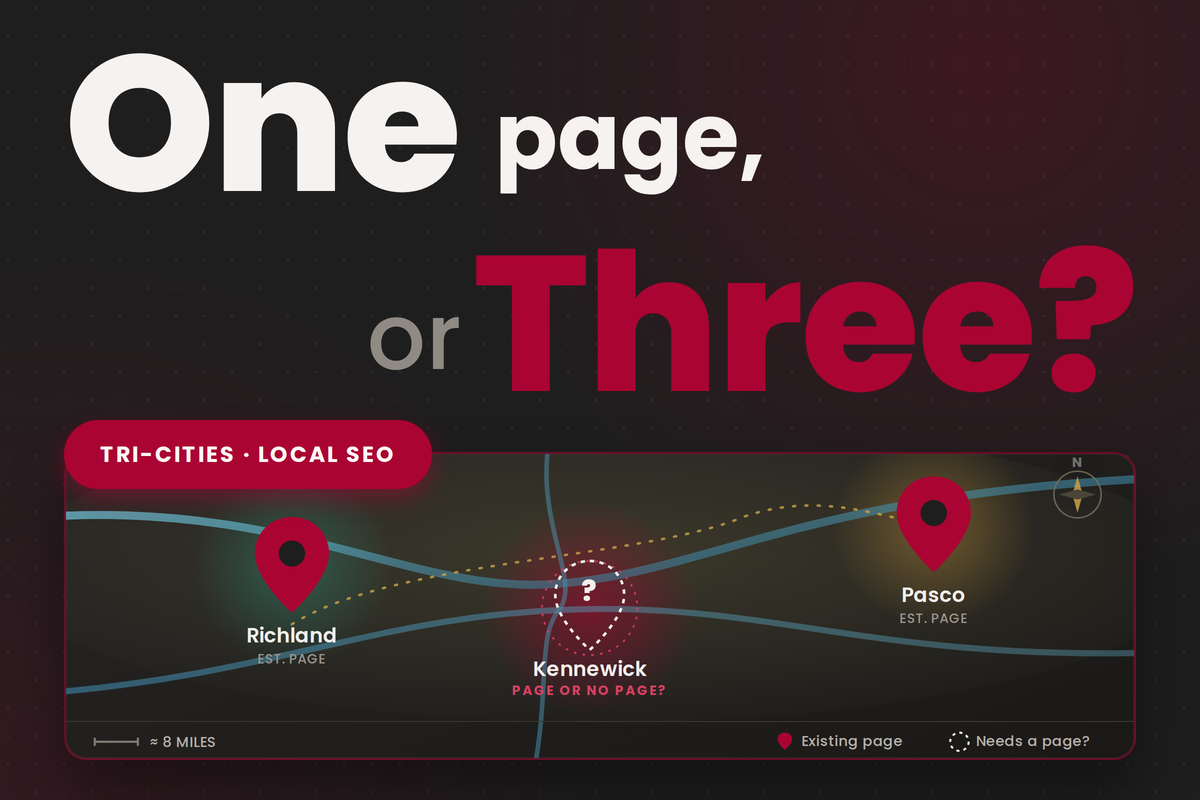
When city-specific pages genuinely help your local SEO — and when they just create duplicate content Google ignores.
Somebody told you that you either need a separate webpage for every city you serve — Kennewick, Richland, Pasco, maybe Prosser and West Richland too — or you’re leaving business on the table. Maybe you’ve seen a competitor’s site with a page for every town in the region and started wondering if you’re already behind.
Here’s the complicated truth: they might be right. Or you might be about to spend a design budget on pages that hurt your business more than help it.
The difference isn’t how many pages you build. It’s whether each one actually earns its place. Google has a specific, current policy against the shortcut version of this idea — building near-identical pages with only the city name changed — and treats it as a warning sign, not a ranking trick.
In this article, we’ll walk through when city pages genuinely help a Tri-Cities business, when they quietly turn into a liability, and how to work through the Kennewick/Richland/Pasco question (plus the West Richland edge case) without guessing.
Before you build a city page for every town you serve, consider this
- Separate city pages only help local SEO when each page represents something real — a distinct location, service area, or offer — not the same content with the city name swapped.
- Google’s spam policies specifically call out “having multiple domain names or pages targeted at specific regions or cities that funnel users to one page” as doorway abuse.
- A single physical location generally needs one strong local page plus an accurate Google Business Profile, not a page for every nearby town.
- A service-area business without a storefront in every city can often serve Kennewick, Richland, and Pasco from one well-built area page instead of three thin ones.
- West Richland is usually only worth a dedicated page if you have something genuinely city-specific to say about it — a real project there, a distinct service boundary, or permitting quirks unique to that city.
- If you can’t fill a page with real, unique detail about a city, that’s the signal it doesn’t need its own page yet.
What “city pages for local SEO” actually means
A city page is a page built to rank for one specific town — usually with the city’s name in the URL, title tag, and headline. The logic sounds reasonable: if you want to show up for “[your service] in Kennewick,” build a page about Kennewick.
That instinct isn’t wrong by itself. Google does reward pages that clearly match a searcher’s location and intent, and a well-built SEO strategy usually includes some location-specific content somewhere on the site.
The problem is how a lot of businesses actually build these pages: duplicate the template, change the city name, publish, repeat for the next town on the list.
That pattern has a name at Google, and it’s not a good one to have attached to your site: doorway abuse. Google’s spam policies list “having multiple domain names or pages targeted at specific regions or cities that funnel users to one page” as a textbook example — filed in the same category as things like keyword stuffing, not treated as a clever shortcut.
When city landing pages genuinely help your business
City pages aren’t the problem. Thin, interchangeable ones are. Here’s when a dedicated page for Kennewick, Richland, or Pasco is the right call.
You have a real, separate location in each city
If you have an actual office, shop, or service location in Kennewick and a different one in Richland, each one deserves its own page — with its real address, hours, staff, photos, and a matching Google Business Profile listing. That’s not a doorway page. That’s a real place with real information a customer needs before they show up.
Your service, pricing, or availability genuinely differs by city
Sometimes what you offer actually changes by location: different permitting rules, a different service radius, different crews or inventory, seasonal availability that varies town to town. When the substance changes, the page should exist to explain that substance, not just to repeat your homepage with a new headline.
If none of that applies to your business — if Kennewick, Richland, and Pasco all get the exact same service, at the exact same terms, from the exact same team — that’s a strong hint you don’t need three pages. You need one page that says so clearly.

When separate city pages become thin duplicate content instead
This is where most small businesses get into trouble, usually without meaning to.
The “swap the city name” template
You’ve probably seen this on other companies’ sites: three or four pages with the identical three paragraphs, identical bullet list, identical photo, and only the city name changes at the top. It looks productive. It isn’t.
Pages built to rank, not to help the person who lands on them
Ask yourself one honest question about each city page you’re considering: if a real Kennewick resident landed on this page right now, would they learn something they couldn’t get from your homepage? If the honest answer is no, the page exists for a crawler, not a customer — and crawlers have gotten good at telling the difference.
Pro tip: If you’re building a page for a city, put something on it that genuinely couldn’t apply to any other city on your list — a specific neighborhood you cover, a real project you completed there, a review from a customer who lives there. That’s usually the fastest way to tell whether a page deserves to exist.
The West Richland question: does it need its own page?
West Richland comes up a lot in this conversation because it sits right next to Richland, shares a lot of the same customer base, and gets lumped in with “the Tri-Cities” in casual conversation even though it’s its own city with its own zip code and its own local pride.
That closeness is exactly why a separate West Richland page is usually unnecessary — unless one of these is true for your business:
- You have a physical location or licensed service territory specifically in West Richland that differs from your Richland coverage.
- West Richland customers ask about something distinct often enough that it deserves its own answer — a permitting quirk, a neighborhood-specific project, a local partnership.
- You’ve noticed real search demand for “West Richland” plus your service specifically, not just as part of general Tri-Cities searches.
If none of those apply, folding West Richland into your Richland page (or a broader area page) as a clearly mentioned service area is usually the more honest — and more effective — move than building a fourth near-duplicate page.
How to decide if your business needs separate pages for Kennewick, Richland, and Pasco
Run through this before you build (or keep) a city page:
- Do you have a real, distinct presence — a location, license, or service boundary — in this specific city?
- Can you write at least a few genuinely unique paragraphs about this city, without repeating your other pages almost word for word?
- Do you have any city-specific proof — a project, a review, a photo — you can actually put on the page?
- Would removing this page and folding its content into a broader area page lose you anything real?
- Are people actually searching for your service plus this specific city, or are you guessing at demand that isn’t there?
A “no” on more than one of these is a good reason to merge that page into a single, stronger area page rather than keep three or four thin ones. A regional service business often gets more mileage from one substantial area page than from a handful of city pages nobody spends real time building out.
This same “is it real, or just SEO wallpaper” test matters just as much for how AI tools decide which local businesses to recommend. Thin, duplicate city pages don’t give an AI system any more confidence in your business than they give Google.
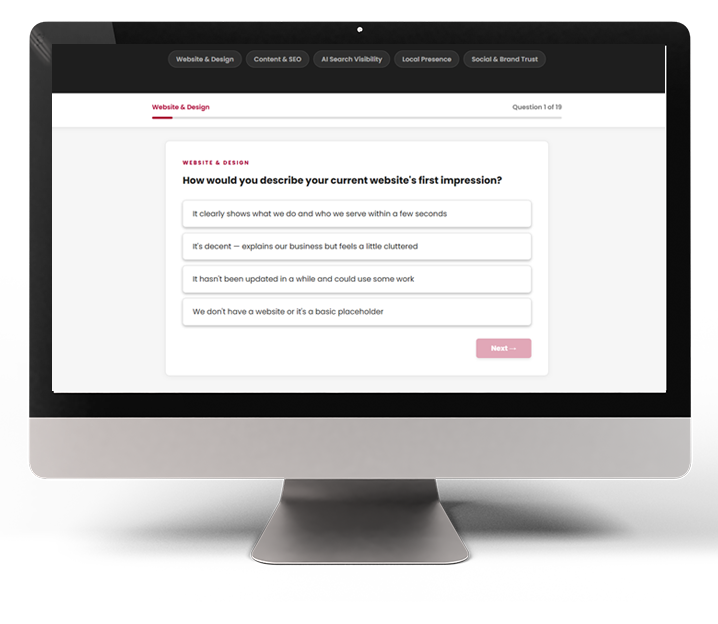
How visible is your brand online?
19 questions across five visibility categories — including where you stand in AI-powered search. Get your free graded report today!
How to start your city-page strategy this week
If you’re researching whether you need pages for Kennewick, Richland, and Pasco specifically, you’re probably trying to do something bigger: get found more reliably in a search and AI landscape that keeps changing. City pages can be one piece of that, but they’re far from the whole picture.
A few articles worth reading next:
If you don’t have city pages yet, you’re not behind — you’re actually in the more common position. Run through the decision checklist above for each city you’re weighing before you spend a design budget on pages you might not need. If your service, pricing, and team are genuinely the same across every town you serve, that’s your answer: build one strong, well-built area page and put your real effort into that instead of a handful of thin ones you’ll rarely update again.
If you already have city pages, pick the three or four weakest ones — the ones you’d struggle to tell apart from each other if the city name were hidden — and decide, honestly, whether each one represents something real. If it doesn’t, don’t delete it in a panic; instead, fold its useful content into one strong area page and redirect the old URL there, so you’re not left with broken links or a confusing website structure.
Either way, the city-page question is really just one input into a bigger one: whether someone searching for what you do — on Google, or through an AI tool now doing some of that searching for them — can actually find you and trust what they see. Get that right, and the city-page decision gets a lot easier to make.
Not sure whether your business needs three city pages, one solid area page, or something in between? Contact Cougar Digital — we’ll look at how you actually serve Tri-Cities and tell you plainly what’s worth building.
Get a FREE marketing analysis & consultation!
In about 30 minutes, we'll cover your:
-
Business Goals and Challenges
-
Current Marketing Efforts
-
Target Audience and Market Insights
-
Competitor Analysis
-
Customized Growth Opportunities

Still curious? There's more where that came from.








Cougar Digital Marketing is a web design and digital marketing agency based in Tri-Cities and Prosser, Washington. We build custom websites, handle SEO, manage digital advertising, and provide photo and video support to help businesses grow. Questions? We're easy to reach.