Why the tactics that work for most local businesses don't move the needle the same way for contractors — and what to do instead.
You post job photos on Facebook, you ask every happy customer for a review, you’ve even run a few ads — and the phone still doesn’t ring the way it’s supposed to. It’s not that you did any of it wrong. Contractor marketing runs on a different set of rules than a restaurant, a retail shop, or a professional service, and the tactics that work for them don’t translate the same way here.
A homeowner deciding between two contractors is making a bigger, riskier decision than most local purchases: they’re letting a stranger into their house, handing over a deposit, and trusting someone to finish a job correctly before they can judge the result. That changes what actually works online.
Let’s talk about what makes contractor marketing structurally different, why that difference carries more weight in a growing market like the Tri-Cities, and what to actually do about it.
Before you run another ad, consider this:
- Contractor marketing carries higher stakes than most local businesses — a customer is letting a stranger into their home or handing over a deposit before seeing the finished result.
- Real project photos and specific reviews do more work for a contractor than for almost any other business, because the quality of the work is invisible until the job is done.
- Emergency repairs and considered-purchase remodels are different buying decisions that need different marketing, even when the same business handles both.
- The Tri-Cities has added real population growth in recent years, and that growth pulls in more contractors chasing the same customer base — which raises the bar for standing out online.
- Specific Google Business Profile categories and visible trust signals matter more here than a generic “general contractor” listing ever will.
- Competing seriously in a market this crowded takes a marketing budget based on what a new client is actually worth — not a flat number that feels safe.
Why contractor marketing follows different rules
Most local businesses sell something a customer can evaluate before they buy: a menu they can read, a product they can hold, a storefront they can walk into. A contractor sells trust in a result that doesn’t exist yet — a homeowner is agreeing to let a crew into their kitchen or up on their roof based on nothing but what they can see beforehand.
That’s why photos of finished work and detailed reviews do so much of the selling in contractor marketing specifically. A restaurant’s Instagram can lean on atmosphere and a good-looking plate; a contractor’s has to stand in for the walkthrough a homeowner can’t take before signing anything. Registration and insurance status matter for the same underlying reason: with the actual work invisible until the crew shows up, the credentials a homeowner can check in advance do some of the trust-building that a visible product or storefront would otherwise handle.
Why the Tri-Cities market raises the stakes
A growing population doesn’t just mean more potential customers. It means more contractors moving into the area to chase that same growth, which makes it harder to stand out by simply existing and doing decent work.
The Tri-Cities added roughly 2,725 residents in 2025 alone, part of a 68% population increase since 2000, according to the Tri-City Development Council. That kind of sustained growth brings steady construction and remodel demand — and it brings a steady stream of new contractors setting up shop to meet it.
In a market that isn’t growing, being the contractor who’s “been around the longest” can carry you. In a market gaining new residents and new competitors every year, a homeowner who just moved to Kennewick or Pasco has no idea who’s been around the longest — they’re comparing whoever shows up first in search, and whoever looks the most trustworthy and current once they click through.
Why competing in Tri-Cities takes a real marketing budget
A crowded, growing market doesn’t just mean more contractors chasing the same customers — it means the ones doing this well are outspending a token effort. A $500-a-month Google Ads budget can disappear fast when a dozen other contractors are bidding on the same handful of high-intent searches in the same metro area.
Contractor work also pays differently than most local purchases. A single remodel or reroof can be worth thousands of dollars in profit — a number that changes what a reasonable marketing budget actually looks like. A business earning that much from one new client can justify spending far more to win it than a business selling something worth thirty dollars ever could, and budgeting like a coffee shop while competing like a remodeler is one of the more common reasons a contractor’s marketing underperforms.
Working backward from what a new client is actually worth — not a flat number picked because it sounds reasonable — is the more useful starting point, and running your own numbers through a marketing budget calculator beats guessing at a round monthly figure.
Not sure what to spend on marketing?
Find out in 30 seconds.
Plug in your numbers, get a smart budget instantly.

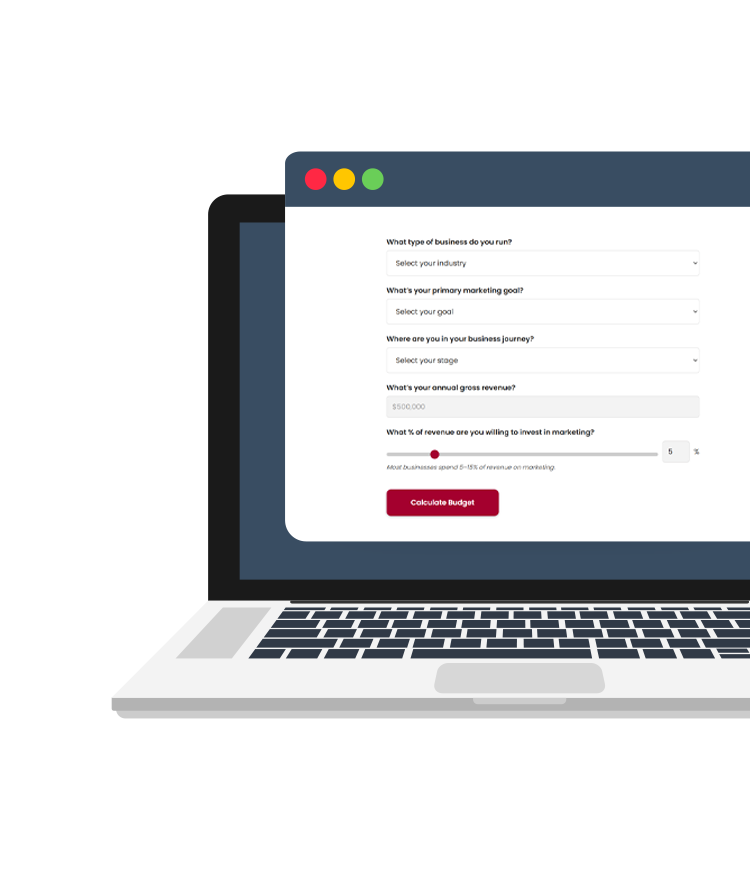
...because 'just throw money at it' isn't a marketing strategy.
Repairs and remodels are different buying decisions
Here’s a difference that trips up a lot of contractor websites: a burst pipe and a kitchen remodel are not the same kind of purchase, even when the same business handles both.
An emergency repair is a same-day decision. The homeowner has a phone in hand and picks whoever answers first with a clear service area and a fast response. A remodel is a considered purchase — weeks of comparing portfolios, reading reviews, and collecting quotes before the deal is done.
That’s really a smaller version of a bigger marketing question: whether a given page should be built for awareness or for generating leads directly. For a contractor, an emergency-repair page is built almost entirely for lead generation (service area, response time, a phone number that’s easy to find), while a remodel page can afford to build awareness and trust first, since the reader has time to look for it.
Try it yourself: Pull up your website and time how long it takes to find your phone number from the homepage. If it takes more than a few seconds, that’s costing you the emergency-repair customers who don’t have time to look.
How Tri-Cities contractors can get ahead in a crowded market
None of this requires a bigger budget — it requires being more specific than the growing number of contractors you’re now competing with.
Choose your Google Business Profile category wisely
Use a specific Google Business Profile category, like “Roofing Contractor,” “Plumber,” or “Kitchen Remodeler,” instead of the generic “General Contractor” as your primary category. Google’s own guidance on Business Profile categories is clear that specificity is what matches you to the right searches. Additional categories can still cover other real services you offer — just make sure the primary one matches what a homeowner is actually searching for.
Use custom, professional branded photography
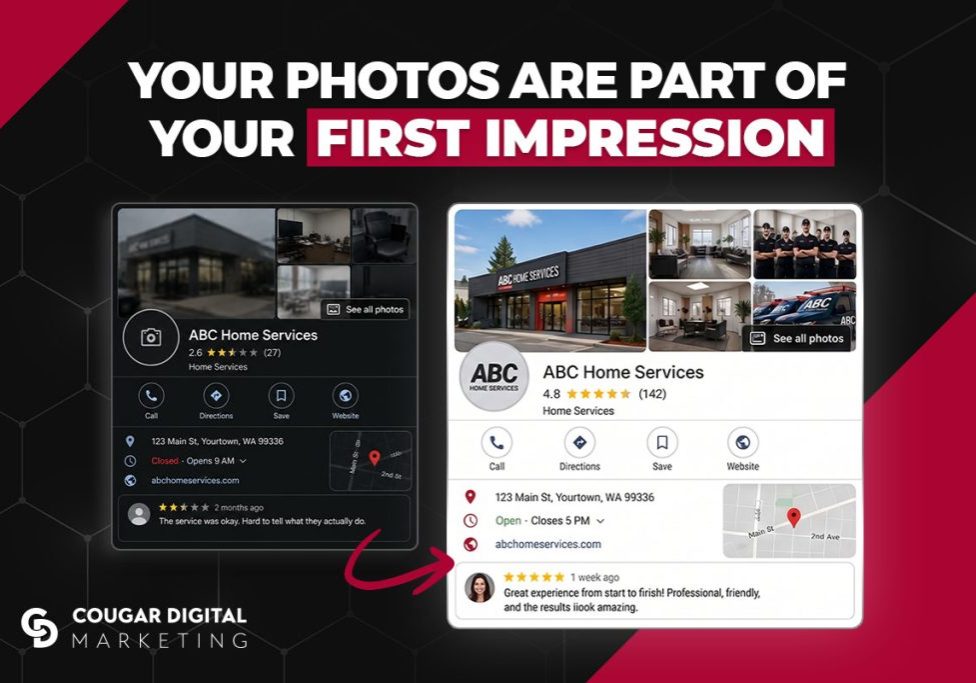
Lead with real project photography over stock images or generic copy — a well-documented job gives a homeowner something concrete to judge, which matters more for a contractor than almost any other business type.
Make your services and contact information clear
Keep your emergency-repair information separate (service area, response time, phone number) and easy to find from your remodel content, even if that just means clearly labeled sections on one page rather than a full second site.
Ask every customer for a review
Ask for reviews that describe the actual work, not just a star rating, and respond to all of them — in a market with more contractors to compare, specificity is what makes one review more convincing than another.
Make your trust signals known
Your registration number and insurance status should be visible and easy to verify, not just technically present somewhere on the site.
How to start marketing your contracting business differently this week
You don’t need to rebuild your whole online presence at once. Pick the one thing from this list that’s weakest right now — a vague Google Business Profile category, a buried phone number, or reviews that don’t say anything specific — and fix that first.
Not sure whether your marketing strategy matches your industry and competition? Let’s talk! We’re happy to take a look and tell you plainly what’s working and what isn’t.
Get a FREE marketing analysis & consultation!
In about 30 minutes, we'll cover your:
-
Business Goals and Challenges
-
Current Marketing Efforts
-
Target Audience and Market Insights
-
Competitor Analysis
-
Customized Growth Opportunities

Still curious? There's more where that came from.









Cougar Digital Marketing is a web design and digital marketing agency based in Tri-Cities and Prosser, Washington. We build custom websites, handle SEO, manage digital advertising, and provide photo and video support to help businesses grow. Questions? We're easy to reach.